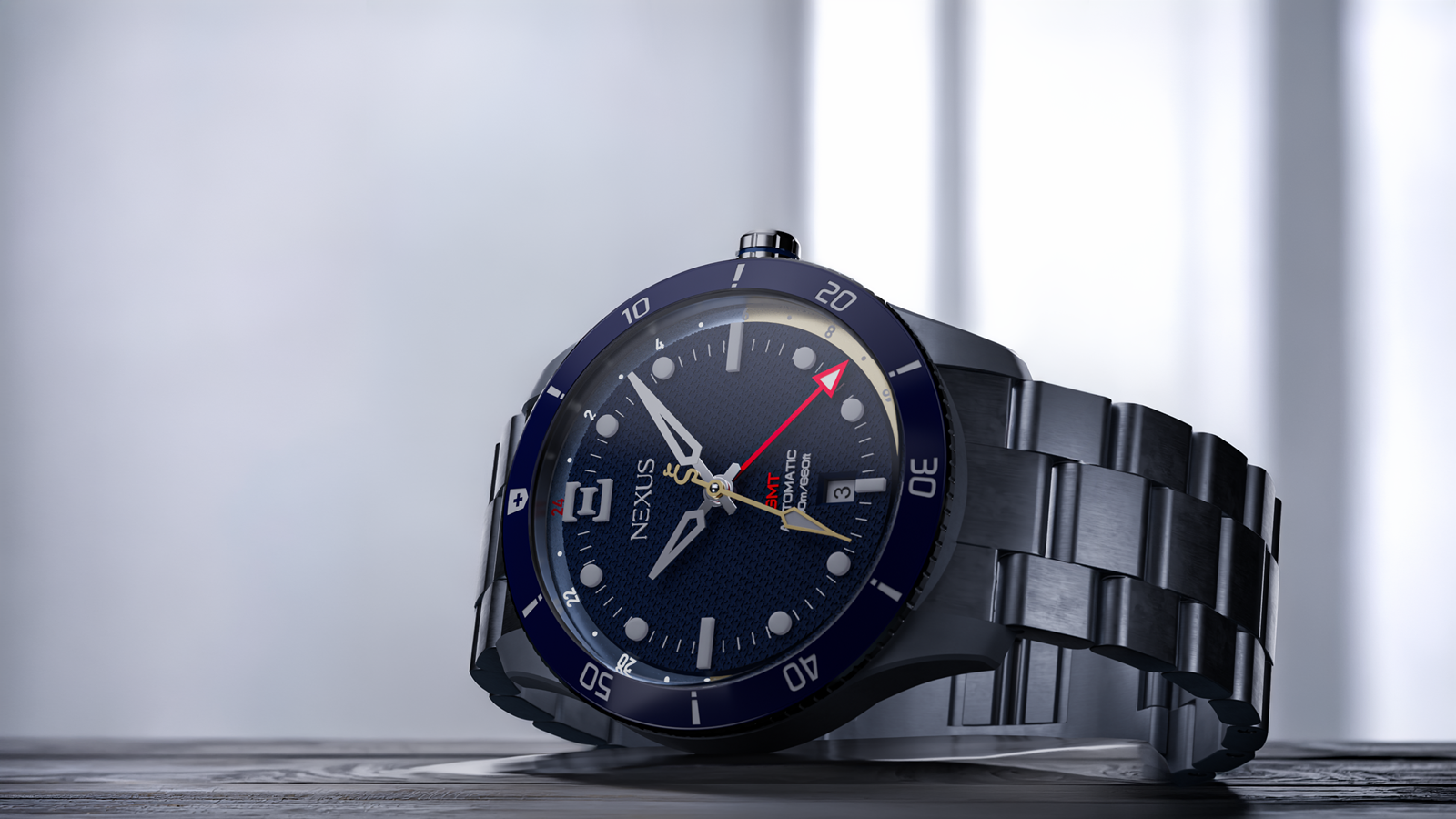
Why We Chose Grade 2 Titanium for the Revival Edition | Nexus Elgin
When we started specifying the Revival Edition case material, stainless steel was the obvious starting point. It's the industry default for a reason, well understood, widely available, easy to machine, and proven across decades of tool watch production.
We ruled it out anyway.
Not because stainless steel is a bad material. It isn't. But when you put it next to titanium and evaluate both honestly against what the Revival Edition is supposed to be, a purpose-built tool watch designed to be worn every day in any condition, titanium wins on every metric that matters.
Here's the technical case.
Weight
This is where titanium separates itself most immediately.
Grade 2 titanium has a density of approximately 4.51 g/cm³. 316L stainless steel, the most common grade used in watch cases, sits at around 7.99 g/cm³. Titanium is roughly 43% lighter than stainless steel by volume.
On a 41mm case with a bracelet, that difference is immediately noticeable on the wrist. A stainless steel version of the Revival Edition would weigh somewhere in the region of 140-160g with bracelet. In titanium that drops to approximately 80-95g.
That's not a marginal difference. That's the difference between a watch you forget you're wearing and one you're constantly aware of. For a watch designed to be worn all day, on a rig, in an office, across time zones, that matters more than almost any other specification.
Corrosion Resistance
316L stainless steel has good corrosion resistance. Titanium has exceptional corrosion resistance.
The reason is the oxide layer. When titanium is exposed to oxygen it forms a stable, self-healing titanium dioxide layer on its surface. This layer is passive, it doesn't react with saltwater, chlorinated water, sweat, or most chemicals encountered in everyday or industrial environments. If it's scratched, it reforms.
316L stainless steel relies on its chromium content for corrosion resistance and performs well in most environments. But in prolonged exposure to saltwater or high-chloride environments, offshore, coastal, or marine use, it can be susceptible to pitting corrosion over time in ways titanium simply isn't.
For a watch rated to 200m water resistance, used by people who work or spend time around water, the corrosion resistance of titanium isn't a premium feature. It's the correct engineering choice.
Grade 2 vs Grade 5
Titanium comes in multiple grades. The two most commonly used in watchmaking are Grade 2 and Grade 5, the latter also known as Ti-6Al-4V, an alloy containing 6% aluminum and 4% vanadium.
Grade 5 is stronger and harder than Grade 2. It's used extensively in aerospace and high-performance applications, and several watch brands use it for cases requiring maximum strength in thin profiles.
Grade 2 is commercially pure titanium, 99%+ titanium with trace elements. It's softer than Grade 5, which actually works in its favor for a watch case. Grade 2 machines more cleanly, takes a better surface finish, and produces the brushed and polished surfaces that define a well-executed case aesthetic. It also has superior corrosion resistance to Grade 5 due to its higher purity.
For the Revival Edition, a 41mm case with defined proportions that doesn't need to be pushed to minimum wall thickness, Grade 2 is the correct specification. The strength-to-weight ratio is more than adequate for the application. The finish quality is superior. The corrosion resistance is better.
Grade 5 would have been over-engineering a solution to a problem that doesn't exist.
How It Feels
Technical specifications tell part of the story. The rest is in how the material actually performs on the wrist.
Titanium has a warmth to it that stainless steel doesn't. It reaches body temperature quickly and holds it, the cold metal feeling you get from a stainless steel watch on a cold morning is largely absent with titanium. The surface texture responds differently to brushing and polishing, producing a more matte, understated finish that sits closer to a tool watch aesthetic than the high-shine of stainless.
At 41mm the Revival Edition wears like a significantly smaller watch than its dimensions suggest. That's the titanium. The case is substantial enough to have presence on the wrist without the weight that can make a larger stainless steel watch feel intrusive after a full day.
The Decision
Stainless steel would have been cheaper to specify and easier to manufacture. It would have produced a watch that looked similar on paper.
On the wrist it would have been a different watch entirely.
Grade 2 titanium was the right material for what the Revival Edition is supposed to be. A tool watch you actually wear. Built to last. Designed to be forgotten on your wrist until you need it.
That was the only specification that made sense.
The revival begins July 28. Secure early access