The Miyota 9075: The Traveller's GMT Movement Inside the Revival GMT
Every watch stands or falls on its movement. The Revival GMT uses the Miyota 9075, and this is the full account of it: what it is, how its GMT works, what it is like to live with, and what it takes to keep one running for the long term.
What the Miyota 9075 movement is
The Miyota 9075 is an automatic mechanical movement made in Japan by Miyota, part of the Citizen Group. It sits in Miyota's 9 series, the range the company calls its Premium Automatic line, and it adds a GMT function and a date to that platform.
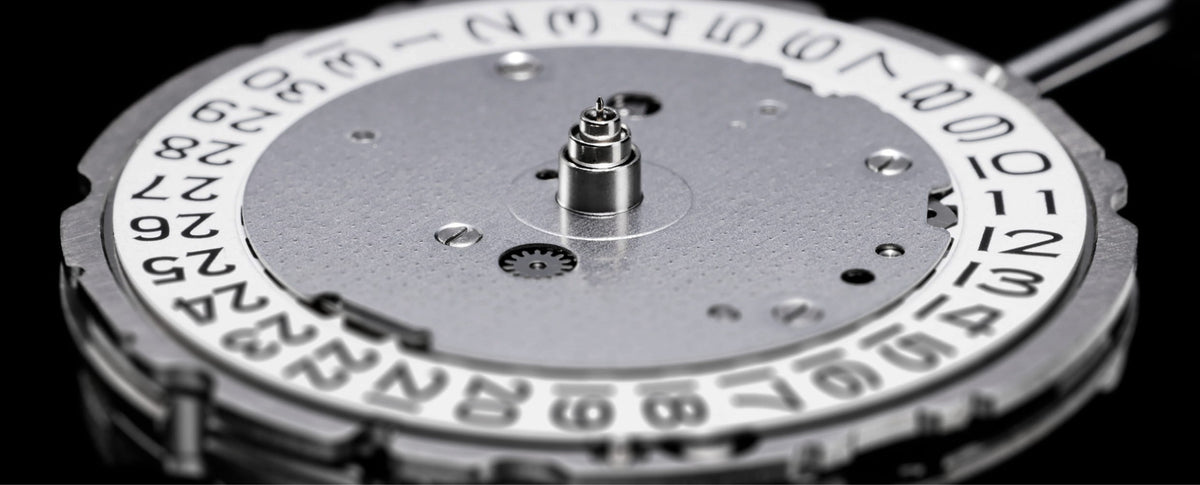
The platform matters. Underneath the GMT work, the 9075 is built on the same architecture as the Miyota 9015, a three hand movement with date that has been in production since 2009 and has earned a solid reputation in watches at this price. When Monochrome took a 9075 completely apart in 2026, it found that the movement side, the part a watchmaker sees first, differs very little from a 9015. Almost everything that makes the 9075 a GMT sits on the dial side, in layers added above the base calibre. That is good news twice over: the base is proven, and the complication is an addition to it rather than a reinvention.
The calibre is recent. The first Miyota 9075 GMT watches were sighted in late 2021, in a LIP Nautic Ski GMT, and the movement's public launch came in July 2022 on the Bulova Classic Wilton GMT. Bulova and Miyota are both Citizen companies, so Bulova was the natural launch partner. Since then the calibre has spread through exactly the part of the market we work in: small brands building serious travel watches without Swiss prices.
A word on the distinction GMT buyers argue about. There are two kinds. A caller GMT lets you adjust the extra 24 hour hand independently while the main hands stay on local time; it suits someone sitting at a desk, tracking another city. A traveller GMT, sometimes called a flyer or true GMT, works the other way round: the main local hour hand adjusts independently, in one hour jumps, while the 24 hour hand keeps home time running. That is the layout Rolex uses on the GMT-Master II, it is the layout a person who actually travels wants, and it is the layout the 9075 uses.
The specification
These are Miyota's own published figures for the calibre. That needs saying, because wrong numbers for this movement circulate in retail listings: at least one seller lists it at 4.10 mm thick with a small seconds dial and a wider accuracy range, none of which matches the official sheet.
| Size | 11½ lignes, 26.00 mm diameter |
| Height | 4.92 mm |
| Jewels | 24 |
| Frequency | 28,800 vibrations per hour (4 Hz) |
| Power reserve | Around 42 hours |
| Accuracy (factory) | -10/+30 seconds per day |
| Positional difference | Under 30 seconds per day |
| Shock protection | Parashock |
| Winding | Automatic and hand winding, with stop seconds (hacking) |
| Functions | Hours, minutes, sweep seconds, 24 hour GMT hand, date at 3 o'clock |
Two figures deserve a sentence each. The height, 4.92 mm, is about a millimetre more than the 9015's 3.90 mm. That millimetre is the entire thickness cost of the traveller GMT mechanism, and it is what allows a GMT watch to stay slim enough to wear every day. And the accuracy range is a factory tolerance, not a promise about any individual watch, a point we return to below.
How the Miyota 9075 GMT works
Under the dial sits what Miyota builds as an hour wheel unit: the cannon pinion, the minute wheel, the index wheel and the hour wheel, held by a small click assembly made of a jumper and an index spring. Pull the crown out one click and turn it, and the hour wheel steps round in clean one hour clicks. The rest of the movement does not know anything has happened. The minute and second hands keep running, and so does the 24 hour GMT hand.
Beside the hour wheel sits a separate 24 hour wheel carrying a small finger, and that finger is what drives the date. Because of that arrangement, the date follows the local hour hand in both directions. Jump forward across midnight and the date advances. Jump backwards across midnight, flying west or crossing the date line, and the date steps back a day. Most GMT movements cannot do that second trick at all.

In wearer terms, travelling with it goes like this. Before a trip, with the crown pulled fully out, you set all the hands together so that the GMT hand reads your home time. When you land, you pull the crown one click and step the ordinary hour hand forwards or backwards to local time. That is the whole job. The watch has not stopped, your minutes are untouched, home time is still on the GMT hand, and if you crossed midnight on the way, the date has already corrected itself. Setting the date works the same way, by jumping the hour hand through midnight. There is no separate quickset, because on a traveller GMT the date is always simply the local date, wherever you have landed.
Living with it
Reviewers who have handled the movement describe the hour hand's click as crisp in both directions, and that matches the mechanism: a spring loaded jumper either seats properly or it does not, and on this calibre it seats. Day to day, the movement asks little. It hand winds, about 40 turns of the crown takes it from stopped to full, it hacks for setting to the second, and the second hand moves in the small, smooth steps of a 4 Hz movement.
The honest limitations first. The power reserve is about 42 hours, which is short for a travel watch. Take it off on Friday evening and it will stop around Sunday lunchtime, and a stopped GMT takes a little more resetting than a three hander, because home time, local time and date all need setting again. The factory accuracy window, -10 to +30 seconds a day, is wide on paper. In practice, owner reports collected by Caliber Corner mostly land between about +2 and +15 seconds a day, and brands can regulate the movement further before sale: Traska, for one, brings its 9075 watches to within 10 seconds a day either way.
Then there is the rotor, and we would rather raise it here than have you discover it. The 9075's rotor winds in one direction and freewheels in the other, a trait of the whole Miyota 9 series. Flick your wrist and you may hear it spin, a soft whir, most noticeable in a quiet room. It is not a fault and it has no effect on timekeeping; it is simply what this movement sounds like. Reviewers of the 9 series note that the sound carries more in lightweight cases, titanium above all, because there is less mass to absorb it. The Revival GMT is Grade 2 titanium, so consider this fair warning: your watch has a voice. We count it as character, but it should never come as a surprise.
Servicing, and the long term
This is the section most movement write ups skip, and it is the one that decides what a watch costs you over twenty years.
The 9075 is built to be serviced, not thrown away. It is a conventional mechanical movement on a proven platform, and any competent watchmaker can strip, clean, lubricate, regulate and rebuild it. Miyota publishes assembly charts for the calibre, and the best evidence of how approachable it is comes from Monochrome's strip down: the writer who took one apart, GMT layers and all, had trained as a watchmaker on a half year evening course, working from Miyota's own charts.

A service on this movement is the standard full service for a modern automatic, with the dial side taken apart in layers to reach the GMT work before the base train underneath. The one place that asks for real care is the hour wheel unit: its jumper and index spring must be seated exactly right on reassembly, or the hour jump will feel vague. Get it right and the click is positive. It is a longer and more careful job than servicing the plain 9015, and it is not work for the cheapest overhaul on the menu, but it is routine work for a proper watchmaker. Even the detail a watchmaker needs for regulation, the 51 degree lift angle, is published.
On intervals, honesty requires a distinction. Miyota does not publish an official service interval for this calibre. The makers who sell it do: Traska recommends a service every five years for its 9075 GMT, and OX Watches says five to six years for its. Five years is the guidance we work to, and it is the interval we will print in the Revival GMT's care instructions.
Costs are where this calibre quietly wins. An independent full service for a 9075 runs roughly $150 to $250 depending on the watchmaker, parts extra: published starting prices for overhauling Japanese automatic movements sit at $150 to $225, and a published review of the Traska Venturer GMT put its 9075 service at around $250. A complete replacement 9075, bought singly at retail, costs roughly $180 to $250. Put side by side, the two routes land close, because a swap still needs a watchmaker to move the dial and hands across, regulate the new movement and reseal the case. We service rather than swap for a different reason: the movement your watch was born with stays in your watch, returned to specification by someone who has seen it inside. Replacement is the fallback for serious damage, not the routine answer.
One part of the picture is not yet strong, and we will not pretend otherwise. Individual component parts for the 9075, the GMT wheels and jumpers a watchmaker might need, are not listed by the traditional parts houses: as of late 2026, Cousins, Esslinger and Perrin carry neither the parts nor the movement. Stems are the exception; they carry a published Miyota part number, 065-A05. A watchmaker who damages a GMT component today works from a donor movement or from the brand's own stock.
So the brand has to hold the stock, and that is what we will do. Miyota supplies the calibre to brands in packages of 100, and from the Revival GMT's production order we will hold back a reserve of complete movements, kept specifically so that a warranty repair never waits on a parts catalogue that does not exist yet. Complete movements have also begun to appear at retail, which helps the long term picture: a watch that any competent watchmaker can service, with whole movements buyable if the worst happens, is a watch with a credible ten year story. What we claim is exactly that, no more.
The honest comparison
Two alternatives were on the table when we chose, and both deserve a fair hearing.
Seiko's NH34 is the default budget GMT, and its strengths are real. It is cheaper than the 9075 by a wide margin, and its support ecosystem is the deepest in this class: every watchmaker knows it, and parts and donor movements are everywhere. But it is a caller GMT, so the hand that adjusts is the GMT hand, not the local hour. It also beats at 3 Hz rather than 4, it is thicker at 5.32 mm, and its factory accuracy range is wider. For a traveller, the function is the wrong way round, and that settled it.
The Swiss route, ETA's 2893-2 or Sellita's SW330 family, buys thinness: the SW330-2 is 4.10 mm tall and runs to about 56 hours of reserve, backed by the deepest parts network of the three. But those are caller GMTs too, and the movement alone costs roughly two to three times the 9075; a replacement SW330-1 retails around $480. Cased and sold, that movement puts a watch well past the price we set for the Revival GMT.
The 9075 is the only traveller GMT in this company, at 4 Hz, thinner than the Seiko, at a Japanese price. Its weaknesses are the ones already named: a 42 hour reserve and a young parts ecosystem. We judged those the right weaknesses to accept.
Why it is in the Revival GMT
Is the Miyota 9075 a good movement? Yes, and the reasons are specific rather than sentimental. It offers true traveller GMT mechanics, the kind that used to cost Swiss money, on a proven Japanese platform. It beats at 4 Hz and stays slim enough for a watch you can wear daily. It can be serviced by any competent watchmaker, and the sums for keeping it running over decades actually work at this price. And its cost is what allows a Grade 2 titanium traveller's GMT to exist at under $1,000. Its trade offs are printed in this article rather than hidden from it, which is rather the point: a movement you can describe honestly, weaknesses included, is a movement you can build a watch around.
The Revival GMT arrives in 2027, launched on Kickstarter. If you would like the occasional letter as it comes together, join the email list; that is where the news goes first.
Movement images and diagrams: MIYOTA (Citizen Watch Co., Ltd.)