Elgin Pocket Watch Serial Numbers: How to Date Yours and Understand Its Value
An old Elgin pocket watch usually arrives with two questions attached. When was it made, and what is it worth? The first has a better answer than most owners expect. The second has an honest one, although it is rarely the simple number people go looking for.
The short answer
Use the serial number engraved on the movement, the mechanical works inside the watch. Do not use the number stamped inside the case.
Elgin numbered its movements in sequence. Put the movement serial into a recognized Elgin database and it will normally give you an estimated production year and, for many pocket watch movements, the grade, model, size, jewel count, configuration and production run. That is enough to turn "Grandpa's old watch" into an identified object with a date, a specification and a place in Elgin's output.
Three cautions belong at the front:
- The result dates the movement, not necessarily the day the complete watch was cased, sold or presented to its first owner.
- Serial dates are estimates. Good references usually place a movement within a year or two, but exceptions exist.
- The serial number does not produce a value by itself. It starts the valuation by telling you exactly what movement you have.
Step 1: Find the movement serial number
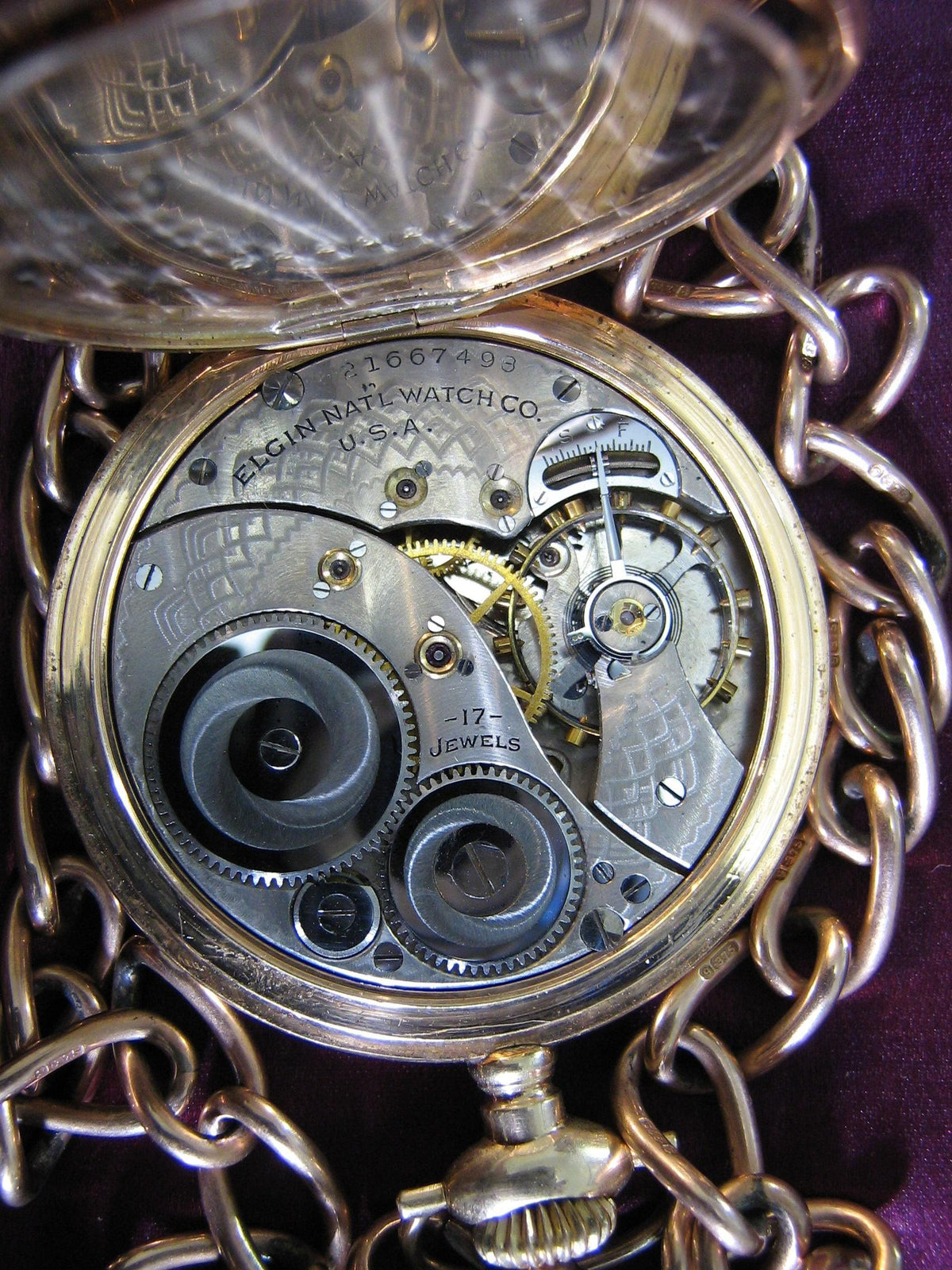
The serial is engraved on the movement plates, normally visible once the back of the case, and sometimes an inner dust cover, is open. Copy it exactly as it appears, including any letter at the beginning. Leave out commas and spaces when entering it into a database.
That letter matters. During the 1930s Elgin began using letter prefixes in place of the opening millions digits on some serials. A number that looks short may therefore represent a much longer factory serial. Do not discard the letter, guess at the missing digits or assume the watch is newer because the visible number has fewer figures. Use a database that understands the lettered series and enter the serial exactly as stamped.
Elgin stopped putting serial numbers on its movements around 1955 to 1956. A later vintage Elgin may need to be dated by its movement type, case design, dial markings and model references instead. A modern watch carrying the Elgin name should not be forced into the old American serial system.
Step 2: Do not date it from the case number
This is the mistake that catches almost everyone.
For much of Elgin's history, movements and cases were separate products. Elgin made the movement. Companies such as Keystone, Wadsworth, Star and the Illinois Watch Case Company made cases, and a jeweler or retailer could combine a movement and case at the point of sale. Each side kept its own numbering.
The case number therefore belongs to the case maker's records, not Elgin's movement sequence. It will not match the movement serial, and that mismatch is normal. It does not mean the watch has been tampered with. Movements were also recased during long working lives, so the case may be younger or older than the movement inside it.
Read the case markings for what they can tell you: the case maker, the material, any guarantee wording and sometimes a model reference. Just do not ask them to date the movement.
Step 3: Use the serial benchmarks for a first date
The table below gives approximate points in Elgin's movement sequence. Find where your serial sits between two points and you have a useful first estimate before running a full database lookup.
| Movement serial around | Approximate production period |
|---|---|
| 9,000 | 1867 |
| 750,000 | 1880 |
| 4,000,000 | 1890 |
| 9,000,000 | 1900 |
| 15,000,000 | 1910 |
| 23,000,000 | 1920 |
| 32,600,000 | 1930 |
| 39,100,000 | 1940 |
| 48,000,000 | 1950 |
| 55,000,000 | 1956 |
Treat these as signposts, not legal boundaries. Production did not move at an even pace, references differ slightly at some points, and a movement could remain in stock before being cased and sold. For a feature, a sale description or an insurance record, use a database result and write "about" before the year.
Step 4: Let the database identify the movement
A good Elgin lookup does more than return a year.
For example, a Pocket Watch Database search for movement serial 29222305 identifies it as a Grade 387, Model 7 movement, with an estimated production year of 1927. It also records a run of 2,000 movements and a much larger total production figure for that grade and model combination. One number has supplied a date, a movement identity and the first clue about how common that particular run was.
Depending on the movement, a lookup may also return:
- Size: Elgin's movement size designation, such as 18s, 16s, 12s or 0s.
- Grade: Elgin's factory designation for the movement's design, finish and quality level.
- Jewels: The number of jewel bearings used in the movement.
- Configuration: Open face or hunting case layout.
- Setting method: Pendant set or lever set, where recorded.
- Finish and adjustments: Details that help distinguish an ordinary movement from a higher grade one.
- Run quantity and total production: Useful context for scarcity, although not a value on their own.
Grade needs one clarification. In this context, grade is the factory's movement designation. It is not a condition grade such as mint, excellent or poor. Two examples of the same Elgin grade can be far apart in value because one is original and working while the other is corroded, incomplete or fitted with replacement parts.
Before you open the case
You may need to open the back to see the movement, but an old watch is not improved by force. Work over a soft cloth, with clean and dry hands, and stop if anything resists.
Most Elgin pocket watches use one of four broad case arrangements:
- Screw back and bezel: The back unscrews counterclockwise, rather like a jar lid. Grip the case body securely and do not twist against the bow or crown.
- Hinged back and bezel: Look for the hinge and a small lip. A fingernail at the lip is often enough. Support the hinge and open it gently.
- Swing out movement: The front bezel unscrews or opens, the crown is pulled out, and the movement swings forward on a hinge. Lift only at the intended notch or edge.
- Snap back: The back is designed to lift at a small notch. Use a proper blunt case knife only if you are certain you have identified the notch. If there is no visible notch, do not invent one with a blade.
If the case is corroded, swollen, cross threaded, unusually tight or valuable, leave it shut and ask a watchmaker who works on vintage watches to open it. Never pry against the dial, lever at the movement, remove screws to get a better photograph or poke at the balance. Do not keep winding a watch that resists or whose service history is unknown.
A clear photograph of the movement is useful. A damaged case hinge, slipped tool mark or broken part is a permanent price for obtaining it.
What the case markings can tell you
Once the case is open, photograph the inside of the back cover as well as the movement. Those markings answer a different set of questions.
A mark such as 14K or 18K points to a solid gold case, subject to proper confirmation. Wording such as Gold Filled, G.F., Warranted 20 Years or Guaranteed 25 Years means something else: a layer of gold bonded to a base metal core. The number of years was the case maker's wear guarantee for that gold layer. It was not a statement that the case was solid gold, and it is not the age of the watch.
That distinction changes value more than almost any other misunderstanding. A gold-colored Elgin is not automatically a solid gold Elgin. Equally, a gold filled case in sharp, unworn condition can be entirely respectable and correct for the watch. Read the mark before reaching for a conclusion.
Silver, nickel and other base metal cases have their own markings and their own collector appeal. Case maker names and trademarks are worth recording exactly, because they help identify the case even though they cannot date the movement.
So what is an Elgin pocket watch worth?
Start with the uncomfortable fact: Elgin made movements on an enormous scale, and a great many survive. Age and the Elgin name alone do not make a watch rare. Most inherited examples are valued as good vintage watches, not as undiscovered treasures. The exceptions are real, but they have specific reasons behind them.
These are the factors that matter.
1. The exact movement
The serial lookup gives you the starting point. Higher grade movements, stronger jewel counts, temperature and position adjustments, railroad grade specification and unusual features generally attract more collector interest than Elgin's high volume everyday movements.
Names need care. B.W. Raymond, Father Time, Veritas and Lord Elgin include desirable watches, but those names were used across different grades, sizes and periods. "B.W. Raymond" is not one watch and does not carry one value. The exact grade and variant settle the question.
Low production can help, but only when collectors want the movement. A small run of something nobody seeks is scarce without being valuable. A larger production high grade railroad movement may be worth more because demand is stronger.
2. Condition and originality
Collectors pay for what has survived honestly.
An original dial without cracks, staining or repainting is worth more than a bright replacement. Original hands, crown, bow and case details matter. Corrosion on the movement, missing parts, damaged jewels, a worn through case or heavy polishing all pull the other way.
Do not polish an inherited Elgin to make it look more valuable. Polishing removes metal, softens engraving and edges, and can erase exactly the originality a buyer wanted. Clean photographs and an honest description are worth more than a shiny case.
3. The case material and its condition
A confirmed solid gold case introduces precious metal value as well as collector value. A gold filled case does not carry the same metal floor, however attractive it is. Silver cases sit in their own market, while nickel and base metal railroad cases are judged mainly on the movement and condition.
Wear matters. Gold filled cases often show brass at the edges and around the bow after decades of use, a pattern collectors call brassing. Deep dents, worn engraving, a loose bow, damaged hinges and a poor fitting replacement back all reduce what a buyer will pay.
4. Whether it runs, and what running means
A watch that ticks is easier to sell than one that does not, but "running" is not the same as serviced, accurate or ready to use every day. Old lubricants dry out, parts wear and a movement can run briefly while still needing a full service.
Ask what is actually known. When was it last serviced, and by whom? Does it run for a full wind? Does it set correctly? Are there missing or replaced parts? A common Elgin can cost more to service properly than the finished watch will sell for, which is why many buyers prefer an honestly described unserviced watch to one with an unknown recent repair.
5. Provenance and completeness
A documented story can matter. Presentation inscriptions, a named railroad employee, military history, original paperwork, a period box, a receipt or a family photograph showing the watch can all strengthen interest. The evidence is what counts. A good story told by the family is worth preserving in full, but it adds less market value if nothing connects it to the object.
Completeness helps where the items belong together. Do not marry a watch to a random old box or chain and describe the result as an original set. Collectors can usually tell, and honesty protects the value that is really there.
6. Sold prices, not asking prices
If you are researching a figure, compare completed sales of the same movement grade, size, case material and condition. Listings that remain unsold only show what sellers hope to receive.
Use a range, not a single magical number. Then adjust for condition, originality, working order, completeness and the selling route. An auction result, a dealer retail price, a private sale and an insurance replacement appraisal are four different figures. They should not be used as if they meant the same thing.
For a solid gold, rare grade or historically documented watch, get a specialist valuation from someone who has examined the watch or, at minimum, worked from complete photographs and the movement record. Photographs of the dial alone are not enough.
A sensible identification routine
If you have inherited or bought an Elgin and want to understand it, work in this order:
- Photograph the front, back, sides, crown and bow before opening anything.
- Record every inscription on the dial and outside of the case.
- Open the case only if you can identify the case type and it moves without force.
- Photograph the movement and the inside case markings.
- Copy the movement serial exactly, including any letter prefix.
- Run the serial through an Elgin database and save the full result.
- Record the grade, size, jewel count, estimated year, run quantity and case material.
- Describe condition without improving it: cracks, wear, corrosion, replaced parts and whether it runs.
- Only then look for completed sales of genuinely comparable watches.
That sequence gives you a record that remains useful whether the watch stays in the family, goes to a watchmaker, is insured or is eventually sold.
Questions owners ask
Can I date my Elgin from the number inside the case?
No. That is the case maker's number. Use the serial engraved on the movement.
Does a higher serial number mean a more valuable watch?
No. It generally means a later movement. Value comes from the exact grade, condition, originality, case, rarity and demand.
My case says "Warranted 25 Years". Is it solid gold?
No. That wording is associated with gold filled cases. The years describe how long the gold layer was guaranteed against wearing through.
What if my Elgin has no movement serial number?
It may date from after Elgin stopped applying serials in the mid 1950s, or the number may not be visible without opening the case correctly. Do not force it. Movement design, case style, dial marks and model references can still narrow the date.
Should I have it serviced before selling it?
Not automatically. A proper service costs real money and may not return its cost on a common model. If the watch is a family piece you intend to keep and use, servicing makes a different kind of sense. If you are selling, disclose what you know and let the buyer decide, unless a specialist advises otherwise for a rare example.
Can Nexus Elgin tell me exactly what mine is worth?
We can help identify and date watches featured through Your Elgins, and explain the factors that affect value. That is not a formal appraisal. For insurance, probate or a high value sale, use a qualified specialist who can inspect the watch.
Show us your Elgin
The serial number tells us when a movement was made and what Elgin built. It does not tell us who carried the watch, where it traveled, why it was engraved or how it came to survive in a drawer for fifty years.
That is the other half of the record, and it belongs to the owners.
Through Your Elgins, we are inviting readers to share vintage Elgin pocket watches and wristwatches, their photographs and their stories. We will research the movement, date what can be dated, say plainly what remains uncertain and feature selected watches in the Journal. A common movement with a documented life can be more interesting than a rare grade with no history at all.
Nexus Elgin is a new company, not the original Elgin National Watch Company. We are based in its home city, and our aim is a modest one: to help revive watchmaking in Elgin, Illinois, in our own small way. The Revival GMT is our first watch, arriving in 2027. If these older Elgins are what brought you here, join the email list and follow the new one as it is built.
Photograph: Ken Heaton, via Wikimedia Commons, CC BY-SA 4.0.